One of the most flexible jobs in games and interactive media, and somehow still one of the hardest to explain. Here's what a TA actually does.
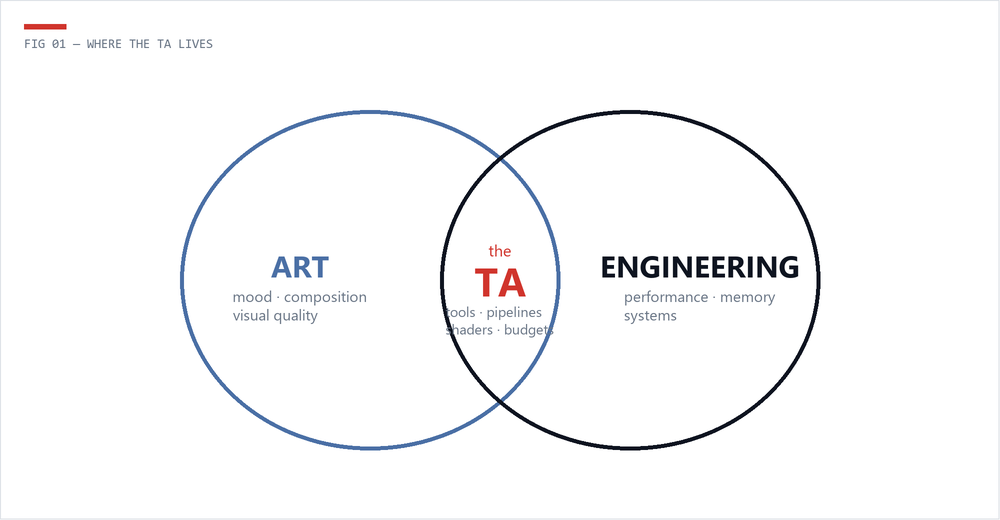
A Technical Artist (TA) sits between art and engineering and helps both sides get the work over the finish line: good looking, shippable, and not held together with hope.
Artists tend to talk in shape, mood, composition, and feel. Engineers tend to talk in frame time, memory, and systems. TAs translate between the two, build tools that give artists more control, keep content inside hardware budgets, and make sure assets can move from DCC to engine without drama.
One good TA can save an art team a ridiculous amount of time by automating the boring bits and cleaning up the handoffs. That's the whole point of the role.
"Technical Artist" is an umbrella title. In a big studio, these can be separate jobs. In a small studio, one TA might cover half of them before lunch.
| Specialization | Focus |
|---|---|
| Shader / Materials TA | Real-time rendering, shader authoring, and material systems |
| Rigging / Animation TA | Character and creature rigging, animation systems, skeletal pipelines |
| VFX TA | Real-time visual effects, particle systems, and simulation |
| Tools / Pipeline TA | Tool development, pipeline automation, and artist workflows |
| Environment / World TA | Large-scale environments, terrain systems, level optimization |
| Lighting TA | Lighting systems, global illumination, light/material interaction |
At leadership level, a Technical Art Director sets the tech art direction, hires and supports the team, and helps decide which pipelines and tools the studio bets on.
No matter the specialty, most TAs need the same base kit:
The job is also problem-solving, clear communication, patience, a service mindset, and the ability to teach without making people feel small. See Soft Skills.
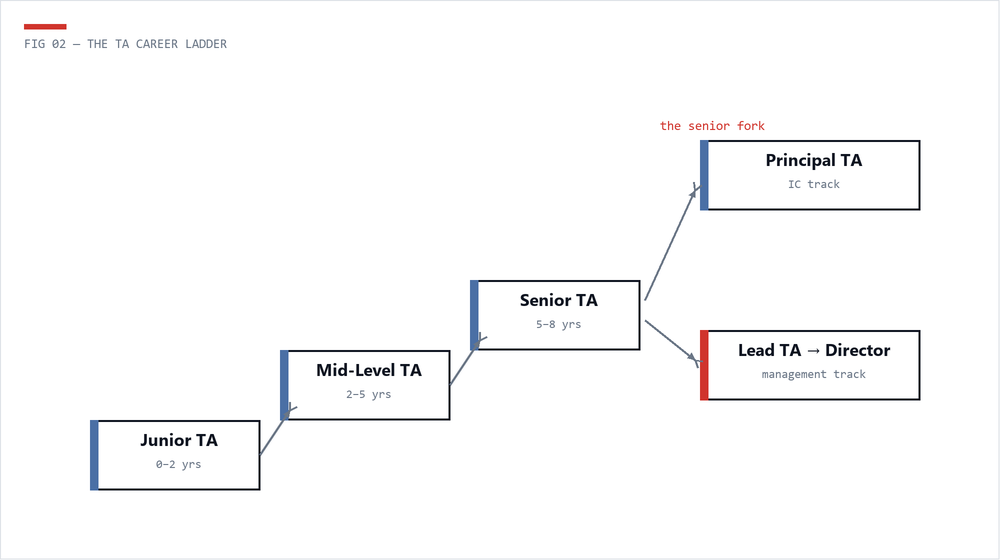
A rough career ladder:
| Level | Years | Scope |
|---|---|---|
| Junior TA | 0-2 | Learning the basics and taking well-scoped tasks with support |
| Mid-Level TA | 2-5 | Owning small tools, features, or workflows without needing constant steering |
| Senior TA | 5-8 | Setting direction for a chunk of the pipeline and helping others level up |
| Principal TA (IC track) | 8+ | Deep expertise and the trust to steer studio-wide technical calls |
| Lead TA -> TA Director (mgmt track) | 8+ | Team leadership, planning, hiring, and unblocking people |
The job changes with studio size. AAA teams may split tech art into narrow specialties. Mid-size teams need people who can wear a few hats. Indie teams might have one TA covering shaders, tools, and pipeline. The constant is problem-solving: tools change, engines change, but people who can untangle weird production problems stay useful.
 The Technical Artist